Good gutter replacement quotes should describe the whole job: the runs being replaced, the gutter system and fittings, the downpipes, safe access, removal of old materials and the checks before handover. A price for “new gutters” leaves too much open to interpretation.
Start by agreeing what needs replacing and why. One leaking joint does not automatically justify renewing every gutter; equally, fitting new channels without addressing weak supports or a blocked discharge route can leave the original problem unresolved. The most useful comparison is between written quotations for the same scope.
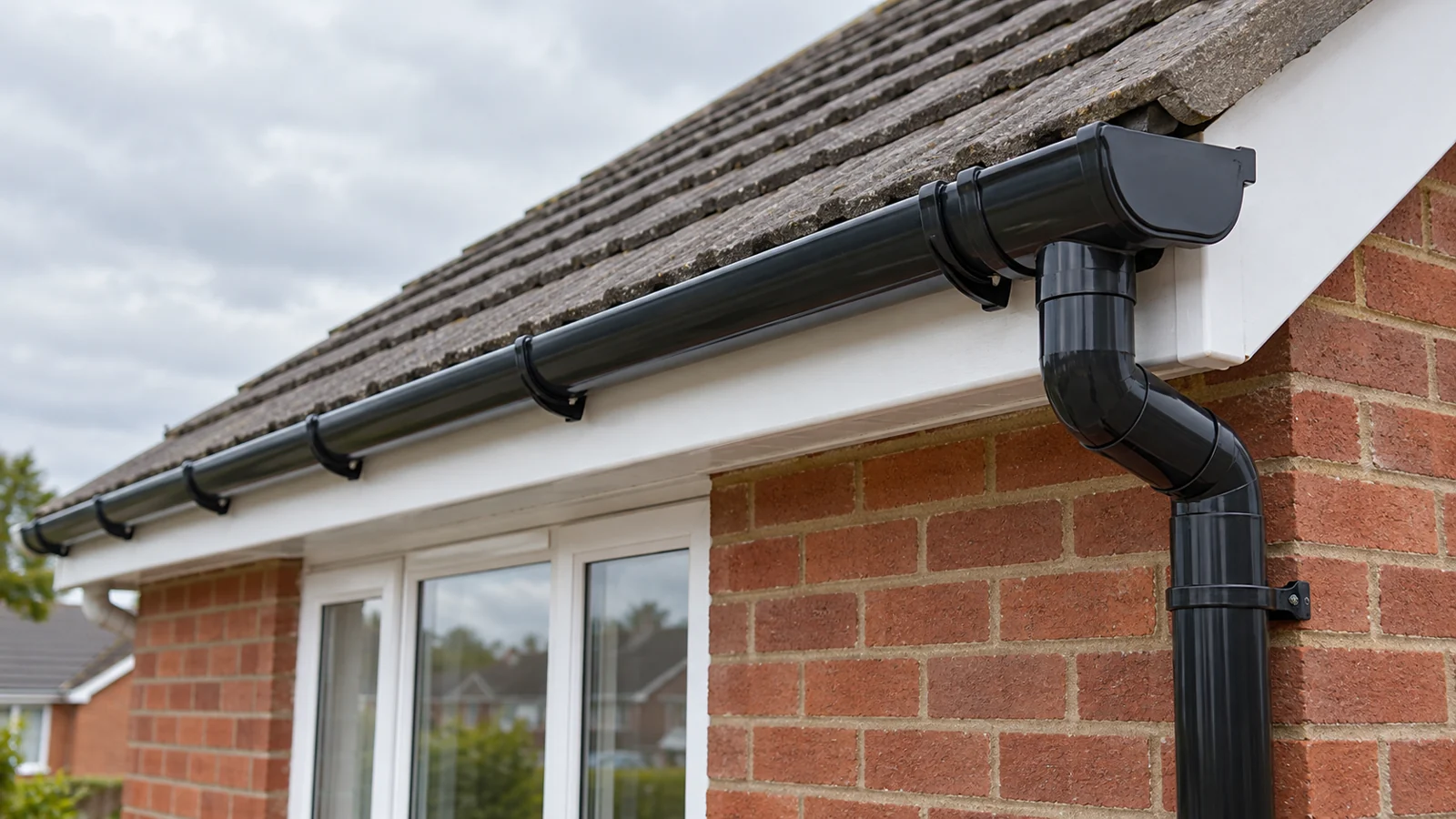
AI-generated illustration of domestic guttering; this is not a completed contractor project.
First, establish which gutters need replacing
Ask the contractor to identify each affected elevation: front, rear, side, extension, garage or porch. A description such as “replace rear gutter between the two corners, including outlet and stop ends” is easier to assess than “replace guttering as required”. Measurements should come from a suitable inspection, rather than your estimate from the garden.
Record the symptoms too. Does water escape from a particular joint, collect in a sagging section or overflow near the downpipe? Photographs taken from a safe position during rain can help explain an intermittent problem. They are a starting point for diagnosis, rather than proof that a particular component needs replacing.
Ask whether cleaning, adjustment or a local repair is a reasonable alternative. Our guide to guttering repairs and replacement decisions explains the distinction. Where replacement is recommended, the quote should give a reason, such as widespread cracking, unreliable joints or a system that cannot be supported securely in its current condition.
What should gutter replacement quotes include?
Use the following checklist when asking for estimates and reviewing a final quotation. An excluded item is not necessarily a problem, provided you understand who will deal with it and how it affects the finished job.
| Item | Detail to request | Why it matters |
|---|---|---|
| Gutter runs | Elevations, approximate lengths and start/end points | Prevents partial and whole-house jobs being compared |
| Materials | Manufacturer, system, profile, size and colour | Makes the specification identifiable |
| Fittings and supports | Brackets, unions, angles, outlets and stop ends | Lengths of channel alone do not form a complete system |
| Downpipes | Which are retained, renewed or altered, including connections | Clarifies where the replacement work ends |
| Access | Equipment, hire arrangements and any permissions needed | Identifies a potentially substantial part of the job |
| Condition and extras | Inspection limits and approval process for concealed defects | Controls unexpected work after removal |
| Completion | Waste removal, flow checks, making good and guarantees | Defines the expected handover |
| Price and terms | Total, VAT treatment, exclusions, validity and payment stages | Allows a fair comparison of payable amounts |
Specify the gutter system, not just its colour
“Black plastic guttering” does not identify its profile or capacity. Ask for the proposed manufacturer and system, nominal size and shape. For metal systems, request the material and finish as well. If appearance matters, agree how the new sections will look alongside retained pipes and neighbouring rooflines before ordering.
Where old and new components meet, the installer should confirm compatibility. Similar-looking parts are not automatically interchangeable. Brett Martin’s rainwater guidance, for example, lists compatibility by system and explains the need to allow for thermal movement in plastic gutter joints. The relevant instructions for the chosen product should govern the installation.
Will the new system deal with the water reaching it?
Replacing a gutter with another of the same size may be appropriate, but repeated overflow deserves investigation. Ask the contractor to consider the roof area feeding each run, the outlet positions and the downstream route. A larger gutter cannot clear a blockage further down the system.
Ask what evidence supports any proposed capacity upgrade. Avoid choosing a deeper profile solely because it sounds more robust. The layout, outlets and downpipes need to work together, with the position of the gutter suited to the roof edge.
Are downpipes included?
Sound downpipes may be retained if their condition, size and connections suit the proposed work. The quotation should identify each retained pipe and describe any new offsets, adaptors or outlets. It should also say whether clearing an existing pipe or investigating a blocked gully is included.
Clarify the boundary between above-ground rainwater goods and underground drainage. A contractor replacing gutters may not be quoting to investigate or repair drains. If water backs up at ground level, agree a separate investigation where needed before assuming that new gutters will solve it.
Access, fascia condition and the extras to agree early
Height is only part of the access question. Conservatories, extensions, narrow side passages, sloping ground and shared entrances can all affect how the work is reached. Tell contractors about these constraints before asking them to confirm a price.
Ask who selects and supplies the access equipment, how long it will remain and whether its cost is included. HSE’s working-at-height guidance explains the principles of planning work and choosing suitable precautions. A low quote should still allow for a suitable working method. Homeowners can prepare photographs and observations from ground level without climbing up to inspect gutters.
What if the fascia is rotten?
The fascia is the board at the roof edge to which many gutter brackets are fixed. Its visible face may not reveal every defect. Ask what the initial inspection can establish and what will happen if removing the old gutter exposes an unsound fixing area.
A useful arrangement is to photograph the finding, explain the proposed repair and obtain written approval of the additional price before proceeding. If an allowance is included, ask exactly what it covers. Full fascia and soffit replacement should not be treated as an automatic consequence of changing the gutter.
If other roof work is already planned, ask whether access can be coordinated. Our article on combining small chimney repairs with other roof jobs considers the questions to ask. Shared access can be useful, but each job still needs its own defined scope and responsibility.
How to compare gutter replacement quotes fairly
Before you begin: gather the quotations, safe ground-level photographs and a simple list of the affected elevations. You need no specialist tools and should not take high-level measurements yourself.
- Write one shared brief. List the affected runs, observed leaks, access obstacles and whether you want alternatives to full replacement considered.
- Match the specifications. Check that each quotation covers the same elevations, gutter system, fittings and downpipe work. Ask for missing details in writing.
- Separate the fixed work from allowances. Mark access costs, exclusions and possible concealed repairs. Ask how any variation will be priced and approved.
- Compare the final payable totals. Confirm whether VAT is included, added or not charged, and check payment stages, quotation validity and cancellation terms.
- Agree the handover before booking. Record the testing, disposal, making good, guarantee terms and contact for reporting a defect.
Consider a simple scope mismatch: one quotation includes gutters and existing downpipe connections; another includes new downpipes, access equipment and waste removal. The second total may be higher because it buys more work. Ask both contractors to price the same agreed specification before drawing a conclusion.
Online guides to guttering prices can help you explore the types of work available and approach local specialists. Treat broad figures as background information. Your property’s layout, condition, access and agreed specification determine the quotation you need.
This article is a scope checklist rather than a national price guide. No fixed installed price is assumed: request a property-specific written total with clear VAT treatment.
What should be checked before the job is signed off?
Agree that the installer will check the new joints, supports and discharge route, and demonstrate water flowing through the completed work where practicable. Ask how retained sections and connections have been checked, particularly if the original complaint was overflow rather than a visible crack.
Keep the final specification, invoice and guarantee information together. Distinguish the manufacturer’s product guarantee from the installer’s workmanship promise; ask about exclusions and any maintenance conditions. Record a contact for problems noticed during the next spell of rain.
New gutters still need maintenance. SPAB’s advice on rainwater fittings recommends regular clearing, particularly after autumn leaf fall, and checking for defects. For older buildings it also cautions that inappropriate replacement materials can affect character. If historic fittings or a listed building are involved, establish the appropriate approach and any consent requirements before authorising changes.
Frequently asked questions
Does a gutter replacement quote normally include downpipes?
There is no universal inclusion. Ask the contractor to name the downpipes being replaced or retained and include any necessary outlet connections, offsets and adaptors in the written scope.
Should I choose the lowest quotation?
Compare the specification and payable total first. A lower quotation may cover fewer runs or exclude access, disposal or downpipe work. Once those differences are resolved, assess the contractor’s proposed method, terms and relevant experience.
Do I need new fascias when replacing gutters?
Not automatically. The supporting area needs to be suitable for the proposed fixings. Ask for its condition to be assessed and agree how any concealed defects will be documented and priced.
Will bigger gutters stop overflowing?
Only if insufficient capacity is the cause and the rest of the system is suitable. Blockages, alignment, outlet positions and downstream drainage should be checked before selecting an upgrade.
Should gutter guards be included in the replacement?
Treat guards as an optional, separately specified item. Ask about compatibility, cleaning access and ongoing maintenance. They do not remove the need to inspect and clear the rainwater system.
Get a clear scope before agreeing a start date
Send the same brief to each contractor and ask them to resolve any missing details before you book. Start with the inspection findings, then compare the complete written scope, final price and handover arrangements. That gives you a clearer basis for choosing than a headline total alone.