

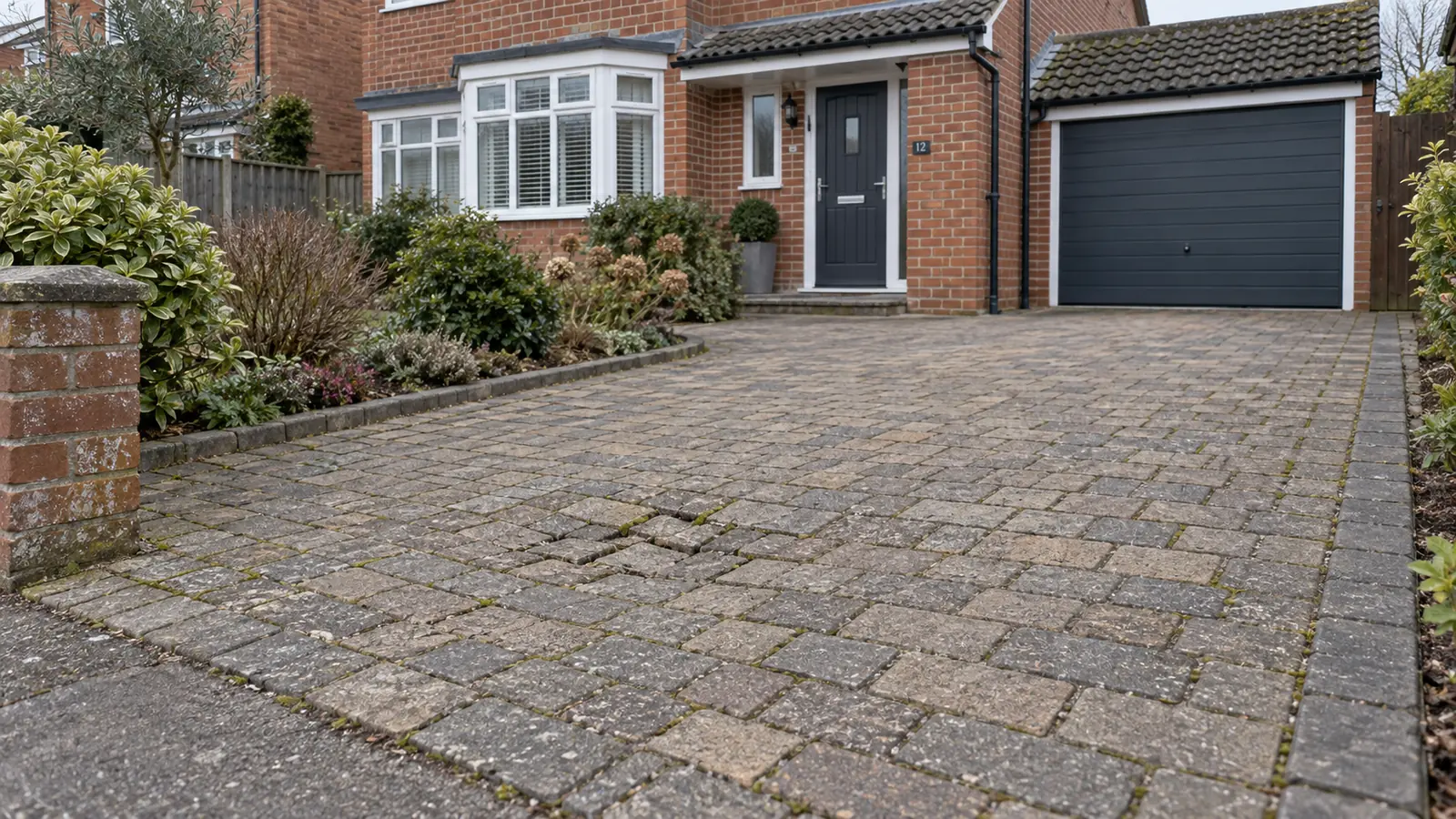
AI-generated illustration of a weathered driveway; not an actual surveyed property.
If the damage is limited and the rest of your driveway is stable, a local repair may be enough. Resurfacing is worth considering when the existing construction can support a new finish. Replacement becomes more persuasive when widespread movement, failing foundations or an unsuitable layout need to be put right.
The difficult part is knowing which situation you have. Faded paving can look worse than it is, while a neat surface can hide poor support underneath. Before deciding on driveway repair or replacement, ask a contractor to explain the cause of the problem and what their proposed work will actually fix.
Repair, resurface or replace: the basic differences
These terms are sometimes used loosely in quotations. Establish exactly which layers the contractor intends to retain.
| Option | What it normally involves | When to investigate it |
|---|---|---|
| Local repair | Work on a defined defect, such as a damaged patch or uneven section of paving | Most of the driveway remains serviceable |
| Resurfacing | Renewing the finish while retaining suitable parts of the existing construction | The supporting structure is sound and the proposed levels work |
| Replacement | Removing the existing surface and rebuilding the necessary layers | Problems are widespread, or drainage and layout need substantial changes |
Replacement does not automatically mean every existing layer must go. Equally, “resurfacing” should not be a vague promise to cover everything over. Ask for the retained and replaced layers to be identified in writing.
When a driveway repair is worth considering
A repair deserves a closer look when the defect is confined to one area and its cause can be addressed there.
For example, a contractor might lift a small sunken section of block paving, investigate the support beneath it and relay usable blocks after correcting the problem. That is different from adding jointing material to paving that continues to move.
Ask three questions:
- Why did this section fail?
- Is the same problem present elsewhere?
- What will prevent the repaired area from failing again?
The supporting layers matter. Marshalls' block-paving guidance explains the role of the compacted sub-base and edge restraints in keeping paving stable.
Appearance is another consideration. Ask whether replacement blocks or patching material will match the existing finish closely enough for you. A sample or a clearly explained repair boundary is more useful than a promise that the repair will be invisible.
Dirt and weeds do not settle the question
Moss, staining and weeds can make a serviceable driveway look neglected. They do not, by themselves, prove that the foundations have failed.
If the surface is stable, investigate cleaning and maintenance appropriate to the paving system before paying for major work. Follow the manufacturer's guidance: a treatment suitable for one surface may be unsuitable for another, especially where permeability needs to be preserved.
When resurfacing makes sense
Resurfacing can be a reasonable option when you want a renewed finish and the existing construction is suitable to retain. Suitability needs a site assessment, rather than a decision based only on photographs.
Ask the installer to check:
- The condition and stability of the existing surface and supporting layers.
- Compatibility with the proposed surfacing system.
- Any cracks, loose areas or previous repairs needing treatment.
- Finished heights at doors, garage entrances, gates and inspection covers.
- The drainage arrangement after the new finish is installed.
Adding a layer raises the surface unless material is removed first. The quotation should explain how thresholds, covers and adjoining paths will be handled, and how appropriate clearances at the building will be maintained.
For resin bound surfacing, the base is part of the specification. Resin Mill's construction guidance describes the importance of the underlying build-up and assessing the supporting ground. Ask your installer to identify the requirements of the particular system they propose.
Do not assume that a permeable top layer makes the whole driveway permeable. Water also needs a suitable route through or away from the construction below.
If you are considering an asphalt finish, our guide to asphalt and tarmac driveways explains the terminology before you discuss specifications.
When replacement deserves serious consideration
Replacement is worth assessing when the problem cannot sensibly be resolved by treating isolated areas or renewing the finish.
Reasons to investigate a rebuild include recurring sinking across several areas, extensive deterioration, displaced edges or a drainage layout that needs substantial alteration. These are prompts for investigation, rather than a diagnosis you can make from appearance alone.
Changing the driveway's shape or making room for different vehicle use may also favour rebuilding. Tell the contractor about the vehicles you expect to park there and any access difficulties you want the new design to resolve.
Ask what evidence supports a recommendation to replace. If a contractor proposes retaining the old base, ask how its condition will be checked. If they propose removing it, ask why that work is necessary.
Sort out drainage before choosing the finish
Observe what happens during rain. Does water collect in a depression, remain beside the garage or flow towards the house? Record the location and show the contractor photographs.
A puddle might reflect a local level problem, blocked drainage or a wider design issue. The quotation should explain the cause being addressed and where the water will go afterwards.
In England, the government's front-garden surfacing guidance says new or replacement driveways can generally use permeable surfacing, or direct rainwater to a lawn or border to drain naturally, without permission under these rules. Traditional impermeable surfacing over 5m² generally needs permission if runoff is not directed to a permeable area.
Check property-specific restrictions with your planning authority. Confirm the applicable requirements locally in Wales, Scotland and Northern Ireland rather than treating England's rules as UK-wide.
Compare the work you need, as well as the price
A patch repair, an overlay and a rebuild are different purchases. Comparing their totals alone will not tell you which offers better value for your driveway.
When researching driveway prices, use your findings to prepare questions for a site visit. My Driveway Prices is a referral service that can introduce homeowners to independent contractors, subject to availability; the contractor assesses and quotes for the work.
Ask for separate written options where more than one approach is suitable. Each should identify the work included, any limitations and the total payable with VAT treatment stated.
Look for clear answers on:
- Removal, excavation and waste disposal.
- Repairs to any retained layers.
- Surface materials and installation specification.
- Edging, levels, drainage and finishing details.
- Possible extra work and how it will be approved.
- Payment stages, care instructions and guarantee terms.
A smaller job may avoid some removal and rebuilding work, but that saving has value only if it addresses the problem. Ask whether the guarantee covers retained construction or applies only to the new work.
How to prepare for a driveway assessment
You will need a phone or camera, a notebook and any previous installation or repair records. This is preparation for a professional assessment; you do not need to lift paving or excavate the driveway.
1. Record the defects
Photograph damaged areas and their position within the driveway. Note whether they have changed or returned after earlier repairs.
2. Observe drainage
From a safe position, record where rainwater collects and flows. Keep photographs to show the contractor.
3. Write down your requirements
List the vehicles using the drive, access problems, preferred appearance and any proposed layout changes. Include your budget priorities.
4. Request suitable options
Ask contractors to explain whether repair, resurfacing or replacement is appropriate, what their assessment is based on and what each proposal leaves in place.
5. Confirm the scope
Before accepting, obtain a written specification, total price, exclusions and terms. Resolve any disagreement about the cause of the damage before choosing the work.
Frequently asked questions
Can a sunken block-paved driveway be repaired?
Sometimes. A localised section may be lifted and relaid after the cause of the sinking is addressed. Repeated or widespread movement needs investigation before deciding whether a local repair is sufficient.
Can I put a new surface over my existing driveway?
Possibly, if the existing construction is suitable for the proposed system. The installer needs to assess its condition, stability, drainage and finished levels before recommending an overlay.
Does every crack mean the driveway needs replacing?
No. The significance depends on the material, extent and cause of the cracking, and whether movement is continuing. Ask for an assessment before choosing between patching, resurfacing and replacement.
Will resurfacing fix puddles?
Only if the proposed work corrects the relevant levels or drainage problem. Ask where water will discharge and how the new construction will achieve that.
Choose the work that addresses the cause
Before committing, you should understand why the driveway has deteriorated, which layers will remain and how the proposed work deals with drainage and future use.
Use that explanation to decide which quotations to pursue. A well-specified repair can be a sensible investment; a rebuild can be justified when it resolves problems that surface work would leave behind.

