

A heat pump hot water cylinder needs more than an empty patch of floor. If you are replacing a combi boiler with an air-to-water heat pump that will also supply your taps and showers, you will usually need stored hot water. Before choosing equipment, ask an installer to check the proposed cylinder location, access, pipe routes and your household’s busiest period of hot water use.
The useful question is not simply whether a tank fits in a cupboard. It is whether the complete installation can fit, be maintained and deliver the hot water you expect. This guide helps you prepare for that conversation without choosing a cylinder size from bedroom count alone.
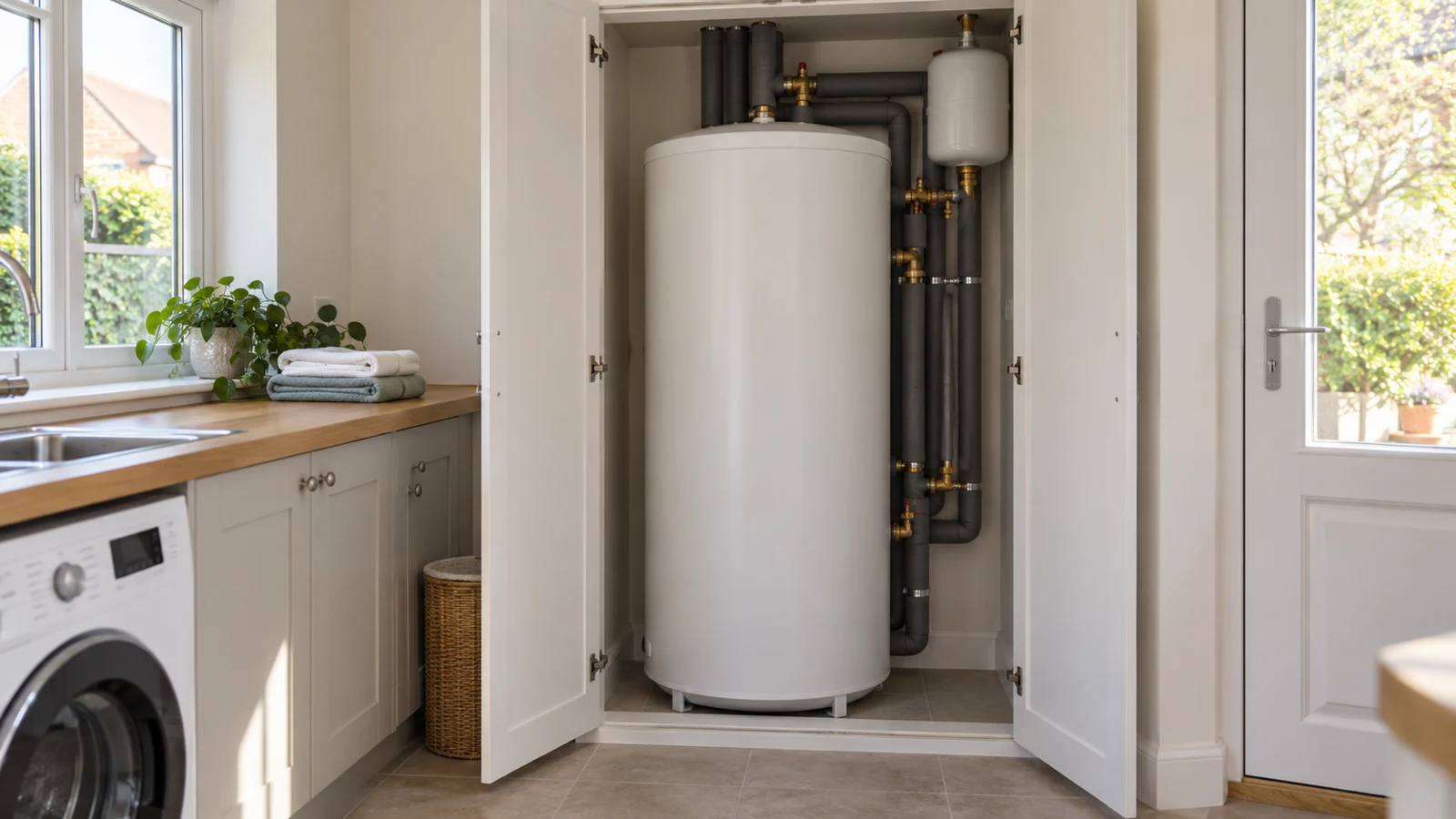
AI-generated illustration of a hot water cylinder in a utility cupboard, not a documented installation or product specification.
Why does moving from a combi boiler change hot water storage?
A combi boiler heats tap water as you use it. A typical air-to-water heat pump installation heats a store of water in advance. The Energy Saving Trust’s air source heat pump guide explains this difference and the need to consider indoor cylinder space alongside the outdoor unit.
For your project, separate two questions: how the home will be heated and how hot water will be supplied. Ask the surveyor to write down the answer to each. A proposal for warm-air heating, for example, should not be mistaken for a complete replacement of your existing hot water system.
Think about the change in routine, too. Tell the installer whether everyone showers before work, whether a bath is filled immediately afterwards and whether visitors regularly stay overnight. Ask how the proposed system would handle that particular sequence, including recovery after the stored supply has been used.
Where could a heat pump hot water cylinder go?
Start with possible locations rather than committing to one. An existing airing cupboard or utility room may be worth investigating, but an installer must assess the actual equipment layout. Baxi’s guidance on heat pump cylinders identifies access, weight-bearing requirements and household water use as design considerations.
Request a dimensioned layout showing the cylinder, associated components and maintenance clearances. A brochure’s cylinder diameter does not tell you the width of the finished installation. Equally, an apparently spacious cupboard can have a doorway or sloping ceiling that changes what can be brought inside.
| Possible location | Question for the surveyor | Detail to request |
|---|---|---|
| Existing airing cupboard | Can the whole installation be serviced here? | A layout with clearances and accessible controls |
| Utility room | What storage or appliances would need moving? | The final footprint and an agreed list of alterations |
| New cupboard | Who builds it, and when? | Separate responsibility for joinery, finishes and equipment |
| Loft or upstairs space | How will support, delivery and later replacement be assessed? | A documented access and support assessment |
| Garage or outbuilding | Is this location suitable for the specified equipment? | The manufacturer’s conditions and proposed pipe route |
Do not move equipment, lift floorboards or climb into an awkward loft to complete these checks yourself. Photographs from safely accessible areas and approximate room measurements are enough for an initial enquiry. Leave installation suitability and any structural assessment to the professionals.
If a cupboard must be rebuilt, ask whether the price includes removing shelving, making good walls and repainting. These are easy items to overlook when one quotation describes only the heating equipment. Our guide to budgeting for home improvements before requesting quotes explains how to separate essential work from optional finishes.
Can you keep the hot water cylinder you already have?
Possibly, but its presence alone does not establish compatibility. Heat pump cylinders commonly use a larger heat-exchange coil to transfer heat effectively at lower water temperatures. An installer should check the existing cylinder’s model and specification against the proposed system rather than assuming a boiler cylinder can stay.
Ask for the retention decision in writing: which cylinder has been assessed, why it is suitable and what performance the installer expects. If replacement is recommended, request the reason. This makes it easier to distinguish an equipment requirement from a preference for a particular installation package.
The Centre for Sustainable Energy’s heat pump advice also discusses hot water storage and whether an existing cylinder can be reused. Its wider guidance is useful background, but it cannot establish that an individual cylinder suits your home.
Choose capacity around your routine, not a universal rule
Rather than asking for a standard cylinder for a three-bedroom house, describe who lives there and when they use hot water. Two households in identical houses can give an installer very different briefs.
For example, imagine one household with two adults who shower at different times and another with several people taking consecutive showers before school. This is an illustrative comparison, not a sizing calculation. Ask each installer to explain their proposed capacity using your actual routine, and to identify any assumptions about shower flow, bath use and reheating.
Also discuss changes already planned: an extra bathroom, a larger bath or family members moving in. If you are considering changes to your bathroom layout, give both trades the same brief so the hot water design and bathroom plans agree.
How to prepare a useful cylinder survey brief
You need a phone or notebook, any existing equipment paperwork and safe access to the rooms you want assessed. This is preparation for a professional survey, not a DIY installation procedure.
- Record the current arrangement. Note whether you have a combi boiler or stored hot water, and photograph any accessible model label without removing covers.
- Describe the busiest hot water period. List the usual sequence of showers and baths, including regular visitors and planned household changes.
- Identify possible locations. Take photographs and approximate measurements of candidate cupboards or rooms. Record doors, stairs and other visible access restrictions.
- List what you want to keep. Explain which storage, appliances and finishes matter, and which could be moved if necessary.
- Request a written proposal. Ask for the cylinder model, capacity rationale, location drawing, access requirements and a clear division of installation and finishing work.
What should the quotation say about hot water?
“Cylinder included” is a starting point, not a complete specification. Before accepting a proposal, ask for answers to these questions:
- Which cylinder and associated components are included?
- What household demand has the design allowed for?
- Which pipe routes and cupboard alterations have been agreed?
- Who removes the old equipment and reinstates disturbed finishes?
- What commissioning, operating instructions and aftercare are included?
- How will the installer demonstrate scheduling, hot water boost and the specified hygiene cycle at handover?
Have the installer explain the manufacturer’s hot water and hygiene settings. Do not reduce stored-water temperatures or disable protective cycles simply to chase lower bills. Ask for written operating instructions appropriate to the installed system.
Keep the scope identical when comparing proposals. If one installer includes a new cupboard and another expects you to arrange it, those totals are not directly comparable. Request clarification before treating the lower total as a saving.
Frequently asked questions
Does every air source heat pump need a hot water cylinder?
No. The answer depends on what supplies your hot water. A typical air-to-water system replacing both boiler heating and hot water usually uses a cylinder. A system with a separate hot water source needs a different assessment.
Can a cylinder go where my combi boiler is now?
Do not assume so. Ask the installer to compare the complete proposed layout with the available space, access and support. A wall-mounted boiler position is not proof that a cylinder can occupy the same area.
Should I buy a cylinder before the heat pump survey?
It is better to agree the system design first. Buying early may leave you with a cylinder that does not match the installer’s specification or the available installation space.
What if I cannot spare an airing cupboard?
Ask the surveyor to assess other locations and explain any alternative hot water arrangement in full. Get its space requirements, installation scope and operating implications before deciding that the project is feasible.
Get the indoor layout agreed before ordering
Take your household brief and possible locations to air source heat pump specialists and ask for a proposal covering hot water as well as room heating. The linked site is an enquiry-matching service for independent contractors, rather than the installer itself; availability depends on the job and location. Confirm who will survey, design and carry out the work before making a commitment.