

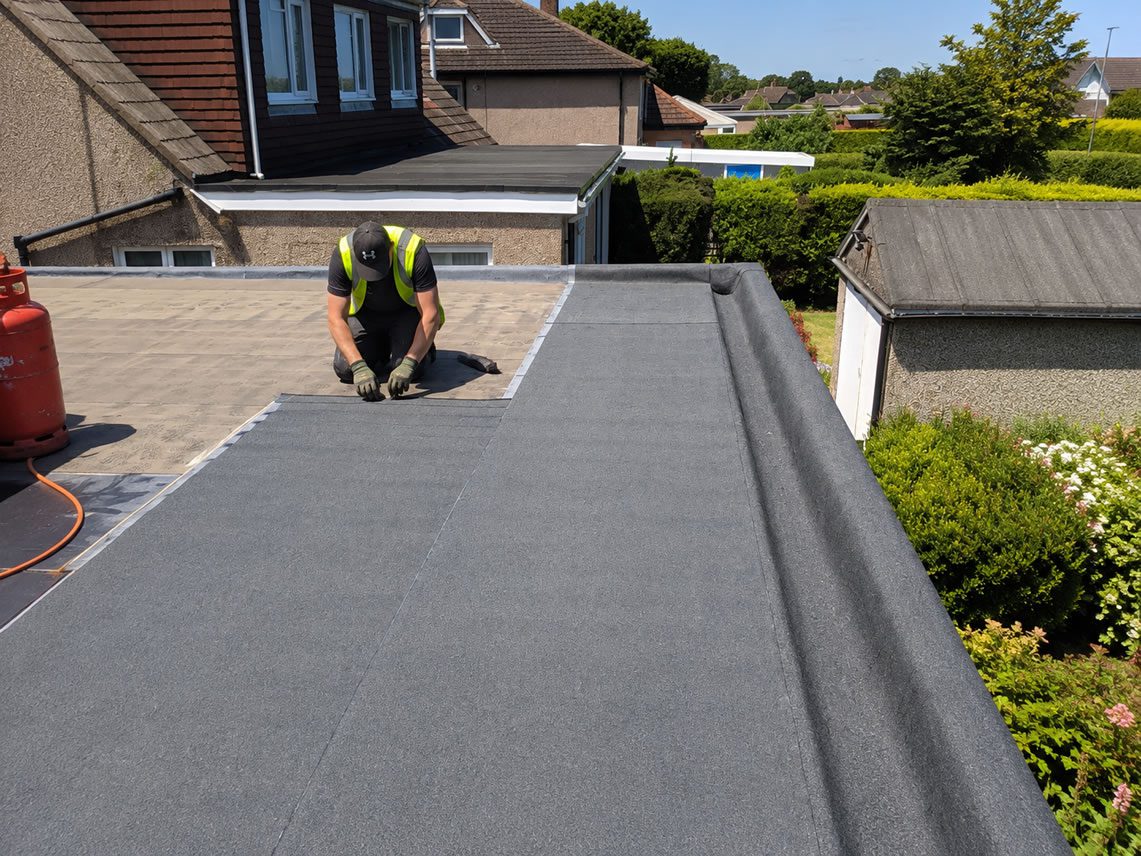
A small split, raised seam or puncture in a felt roof can quickly lead to damp decking, damaged insulation and staining inside the building. Fortunately, not every defect requires an immediate full roof replacement.
Some localised problems can be repaired using a felt patch, bitumen adhesive, repair tape or a fibre-reinforced liquid compound. UK retailers now stock a wide selection of DIY felt roof repair kits, from small emergency sealants to complete cold-applied patching systems.
However, the right product depends on the defect. Spreading roof paint over a rotten deck or repeatedly sealing a failed seam will not create a dependable repair. Before buying a kit, it is important to understand where water enters, whether the surrounding felt remains sound and whether it is safe to access the roof.
This guide explains the main felt roof repair options, the products commonly included in DIY kits, likely costs and the point at which professional repair or replacement becomes the better choice.
Can a felt roof be repaired?
Yes. A felt roof can often be repaired when the defect is small and the surrounding roof remains in reasonable condition.
Repair may be suitable for:
- one small puncture
- a local crack or split
- a short section of open seam
- felt lifting at one accessible edge
- a small dry blister
- minor damage around a fixing
- local wear around an outlet
- a temporary emergency leak
Replacement may offer better value where:
- cracks appear across several areas
- the felt has become brittle
- numerous seams have opened
- large sections have blistered
- insulation is wet
- the timber deck feels soft
- the roof sags or holds deep water
- old patches repeatedly fail
- the roof leaks from several locations
A repair only performs as well as the surface beneath it. Adhesive and liquid coatings will not restore decayed timber or saturated insulation.
Common felt roof defects and suitable repair products
| Defect | Possible DIY repair | When to use a roofer |
|---|---|---|
| Tiny puncture or nail hole | Bitumen repair compound or self-adhesive patch | Leak continues or deck is soft |
| Short surface split | Reinforced repair tape or felt patch | Split is widening or appears in several places |
| Open seam | Cold-applied felt adhesive and patch strip | Seam is wet, contaminated or widely detached |
| Lifted edge | Compatible adhesive and secure edge detail | Perimeter trim or decking has failed |
| Small local blister | Specialist repair after confirming it is dry | Blister contains water or several blisters are present |
| Cracked upstand | Reinforced liquid compound or new felt detail | Junction has pulled away or flashing has failed |
| Worn mineral finish | Compatible roof coating | Membrane is cracked, loose or saturated |
| Ponding area | Clear outlet only if safely accessible | Roof has poor falls or a sagging deck |
| Major tear | Temporary reinforced patch | Permanent professional repair usually needed |
What is included in a DIY felt roof repair kit?
There is no single standard kit. Some contain a tin of repair compound, while others provide all the materials required to apply a reinforced patch.
A kit may include:
- bitumen roof repair compound
- roofing felt adhesive
- self-adhesive flashing or repair tape
- replacement roofing felt
- reinforcement scrim or fabric
- primer
- application brush
- disposable gloves
- mixing stick
- seam roller
- installation instructions
Before ordering, check the coverage and the surfaces for which the product is approved. A product intended for emergency patching may not be suitable for coating an entire flat roof.
Main types of DIY felt roof repair products
Bitumen roof repair compound
Bitumen repair compound is a thick waterproof material applied with a brush, trowel or filling knife. Fibre-reinforced versions can bridge small cracks and gaps.
It is commonly used for:
- small splits
- punctures
- leaking joints
- emergency repairs
- details around pipes and flashings
Bostik currently describes its roof repair compound as a single-application waterproofing product for emergency repair and general roof maintenance. Screwfix lists a 1 kg container at £21.79 at the time of writing. Product availability and pricing can change.
Advantages
- readily available
- simple to apply
- useful for irregular details
- some products work in damp conditions
- relatively inexpensive
Limitations
- unsuitable for rotten decking
- may provide only a temporary repair
- thick applications can crack
- surface preparation still matters
- may not match every existing membrane
Cold-applied roofing felt adhesive
Felt adhesive bonds new felt or patch material to timber, concrete, metal and existing compatible roofing felt.
Bostik Feltfix is a cold-applied waterproof bituminous adhesive intended for bonding roofing felt. Its stated coverage is approximately 0.6–0.8 square metres per litre, while a 5-litre container is currently listed by Screwfix at £26.99.
Sika Black Jack roofing felt adhesive is another cold-applied product sold for bonding felt to substrates such as timber, concrete and metal and for sealing overlaps and corners.
Best used for
- bonding a replacement felt patch
- resealing a limited overlap
- securing felt on a small outbuilding
- sealing compatible felt edges
Not suitable for
- filling deep holes
- coating an entire roof as a substitute for membrane
- sticking felt over standing water
- repairing wet or rotten timber
- rebuilding failed upstands without proper detailing
Self-adhesive felt repair tape
Repair tape is normally supplied in a roll with a peel-off backing. It can be useful for small tears, open laps and punctures.
For a typical small patch:
- clean the surface
- allow it to dry where the product requires a dry surface
- cut the tape larger than the damaged area
- round the corners
- press it down firmly
- roll out air pockets
- seal the edges if required by the manufacturer
Roofing Megastore’s DIY guidance recommends making a repair patch at least 50 mm larger than the damage in every direction and rolling it down to remove bubbles.
Advantages
- no open flame
- quick to apply
- little mess
- suitable for small local defects
Limitations
- adhesion depends heavily on preparation
- rough mineral felt may need primer
- poor-quality tape can lift at the edges
- not suitable for widespread deterioration
Replacement felt patch and adhesive
A traditional cold-applied patch uses a piece of compatible roofing felt and bitumen adhesive.
This approach can suit:
- a straight split
- a puncture
- damage around a previous fixing
- a limited area of worn felt
The patch should extend beyond the defect on all sides. Rounded corners help reduce the chance of the edges lifting.
The exact overlap, adhesive and fixing method should follow the product manufacturer’s instructions.
Fibre-reinforced liquid roof repair
Fibre-reinforced liquid products combine a coating with embedded fibres. They can bridge small gaps without requiring separate reinforcement fabric.
Sika Evercryl is currently marketed as a one-coat emergency roof repair product that can be applied in damp conditions and used on several non-porous roofing materials.
Suitable uses may include
- local cracks
- leaking details
- emergency weatherproofing
- difficult corners
- small joints around penetrations
Points to check
- compatibility with bituminous felt
- whether primer is required
- minimum and maximum application temperature
- whether the product can tolerate standing water
- coverage per container
- required thickness
- curing time
Liquid waterproofing kits
Larger repair kits may include primer, liquid membrane and reinforcing fabric. These can form a continuous patch over a wider area.
Roofing Megastore currently lists flat roof repair materials including crack and joint filler, ponding filler and liquid roofing products.
These kits can be useful where a simple strip of tape will not accommodate the shape of the repair. However, applying a liquid membrane across a wide area requires careful preparation and correct detailing at edges and outlets.
Emergency roof sealants
Cartridge sealants and mastics can stop a small leak temporarily. They are useful for:
- a narrow crack
- a gap at a trim
- a small joint
- an emergency repair before professional work
They should not become the default treatment for:
- long open seams
- cracked felt across a wide area
- wet insulation
- sagging decking
- failed roof drainage
- repeated leaks
DIY repair product comparison
| Product type | Best for | Typical cost | Expected role |
| Cartridge roof sealant | Narrow gaps and emergency sealing | £5–£15 | Temporary or minor local repair |
| Bitumen repair compound | Cracks, punctures and awkward details | £15–£40 | Emergency or local repair |
| Self-adhesive repair tape | Straight tears and short open seams | £15–£60 | Local repair |
| Felt adhesive | Bonding felt patches and laps | £10–£40 | Part of a patch repair |
| Felt patch material | Replacing a damaged surface section | £15–£80 | More substantial local repair |
| Reinforced liquid repair kit | Cracks and irregular details | £40–£150 | Medium local repair |
| Larger liquid membrane kit | Wider stable repair area | £100–£400+ | Repair or overlay after assessment |
| Full shed felt kit | Refelting a small garden building | £50–£250+ | Complete covering for a small outbuilding |
These are broad retail budgeting ranges. Brand, coverage and product type can change the final cost.
Popular UK brands and retailers
Homeowners may encounter products from brands including:
- Bostik
- Sika
- Everbuild
- Black Jack
- Cromar
- IKO
- Roof Pro
- Corrapol
- Acrypol
- Evercryl
Common retailers and roofing merchants include:
- Screwfix
- Toolstation
- B&Q
- Wickes
- Roofing Megastore
- Roofing Superstore
- local roofing merchants
- builders’ merchants
Toolstation currently stocks roof repair products from brands including Sika, Everbuild, Bostik, Corrapol and others. Its roof repair category includes sealants and waterproof repair coatings.
Screwfix currently lists Bostik felt adhesive, repair compounds, roofing sealants, felt rolls and garden-building roofing kits.
The presence of a product at a major retailer does not mean it is suitable for every roof. Always read the technical and safety information for the specific product.
Repair kits for a shed versus a house extension
A DIY kit suitable for a low garden shed is not necessarily appropriate for an extension attached to the home.
| Consideration | Garden shed | Garage | House extension |
| Consequence of leak | Stored items and timber damage | Vehicle or storage damage | Internal ceilings, insulation and electrics |
| Typical access | Low | Low to medium | Often higher or awkward |
| Roof insulation | Usually none | Sometimes | Common |
| Vapour control | Usually simple | Varies | Important |
| Internal finishes | Minimal | Limited | Plasterboard and decoration |
| DIY suitability | Often reasonable | Depends on size and access | Professional assessment usually preferable |
| Repair standard | Basic weather protection | Durable repair desirable | Full building-standard waterproofing needed |
Screwfix’s shed-roof guidance distinguishes basic bitumen felt from longer-lasting membrane kits and notes that shed refelting can be manageable for a competent DIYer. It also advises against felting in rain because water can become trapped and interfere with adhesive.
Temporary repair or permanent repair?
Not every product labelled “roof repair” provides a permanent solution.
A temporary repair may be appropriate when:
- bad weather prevents a full repair
- a contractor is already booked
- the damage is small
- the aim is to reduce water entry immediately
- the roof will soon be replaced
A longer-term repair should:
- identify the actual entry point
- remove loose or failed material
- dry the repair area
- bond to sound membrane
- extend sufficiently beyond the defect
- maintain drainage
- integrate with edges and upstands
- avoid trapping moisture
- withstand sunlight and temperature movement
Ask whether the product manufacturer describes the application as an emergency repair, maintenance coating or full waterproofing system.
How to find a leak in a felt roof
Water often travels between felt layers or along the roof deck before appearing inside. Therefore, the ceiling stain may not sit directly below the defect.
Start with the internal signs
Record:
- where water appears
- whether it drips or forms a stain
- whether it happens during light or heavy rain
- whether wind direction affects it
- whether staining occurs near an edge, wall or rooflight
- whether the ceiling feels soft
Inspect the roof from a safe position
Look for:
- cracks and punctures
- open seams
- bubbles
- lifted edges
- debris around outlets
- standing water
- failed upstands
- damaged trims
- recent aerial or satellite fixings
- branches or impact damage
Do not walk across an unconfirmed flat roof. Wet decking may not support your weight.
How to prepare felt for a repair
Surface preparation is often the difference between a successful patch and one that lifts within weeks.
The preparation required varies by product, but commonly includes:
- removing loose dirt
- brushing away mineral granules that are no longer attached
- removing moss and vegetation
- cleaning grease or contamination
- allowing the surface to dry where required
- cutting away only clearly loose material where the instructions permit
- applying primer if specified
- rounding the patch corners
- extending the patch beyond the damaged area
Do not seal over trapped water. If water emerges when pressing a blister or opening a failed seam, the roof may need a more extensive inspection.
When DIY felt roof repair is reasonable
A cold-applied DIY repair may be reasonable where:
- the roof belongs to a low shed or accessible outbuilding
- the defect is clearly visible
- damage is small and isolated
- the decking is firm
- the surrounding felt remains flexible and bonded
- there is no standing water at the repair
- safe access is available
- the product is designed for the existing felt
When not to attempt DIY repair
Call a roofer where:
- the roof is above a home or occupied room
- access requires walking on the roof
- the roof is two storeys high
- the deck feels soft or sags
- water is near electrical fittings
- the ceiling is bulging
- several leaks exist
- the felt has widespread blistering
- insulation may be wet
- the leak returns after patching
- the roof requires torch-applied felt
- structural timber may be damaged
- asbestos-containing materials could be present nearby
Why homeowners should avoid torch-on DIY repairs
Torch-on felt uses an open gas flame to heat and bond the membrane. This creates a serious fire risk, particularly around:
- timber decks
- roof voids
- insulation
- wall cavities
- fascia boards
- dry debris
- combustible building materials
Professional roofing guidance contains specific safety requirements for work involving gas torches, reinforced bitumen membranes and hot works. A cold-applied DIY product is safer for a small suitable repair, but full torch-on installation belongs with trained roofers who have suitable fire precautions and insurance.
Can you repair felt in wet weather?
Some emergency products can be applied to damp surfaces. However, this does not mean every repair should be completed in rain.
Wet conditions can:
- reduce adhesion
- trap moisture
- make the roof slippery
- prevent proper cleaning
- hide the full extent of the defect
- wash uncured products away
- increase the risk of falling
Use only a product specifically approved for damp application and treat it as an emergency measure where appropriate.
Felt roof repair costs
DIY materials
| DIY repair | Typical material cost |
| Small sealant repair | £5–£20 |
| Bitumen compound repair | £15–£40 |
| Repair tape patch | £15–£60 |
| Felt and adhesive patch | £30–£100 |
| Reinforced liquid repair | £40–£150 |
| Wider liquid repair system | £100–£400+ |
| Refelting a small shed | £50–£250+ |
Professional repair
| Professional job | Broad UK budgeting range |
| Inspection and small local repair | £150–£400 |
| Repair around an edge or upstand | £250–£700 |
| Seam or larger patch repair | £250–£800 |
| Local deck repair and refelting | £500–£1,500+ |
| Multiple repairs or partial renewal | £750–£2,500+ |
| Complete felt roof replacement | £2,000–£8,000+ |
Access, roof size, location, wet insulation and deck damage can raise the cost considerably.
DIY repair cost versus professional work
| Factor | DIY kit | Professional repair |
| Upfront cost | Lower | Higher |
| Leak diagnosis | Homeowner responsibility | Roofer should investigate |
| Access safety | Homeowner responsibility | Contractor provides safe system |
| Product compatibility | Must be checked by homeowner | Roofer should specify system |
| Hidden deck damage | Easily missed | Can be inspected |
| Guarantee | Product warranty only | May include workmanship |
| Best for | Small accessible outbuilding repairs | Homes, garages and complex defects |
Common DIY repair mistakes
Applying a patch to a dirty surface
Dust, moss and loose mineral granules prevent adhesion.
Making the patch too small
Water can enter around an edge close to the original split.
Leaving square patch corners
Sharp corners can be more likely to lift. Rounded corners usually perform better.
Repairing only the visible ceiling position
Water may have entered farther uphill and travelled beneath the felt.
Coating over a blister
This can trap moisture and may not stop the blister from splitting.
Filling a sagging pond with repair compound
Filler does not correct a weak deck or inadequate roof falls.
Mixing incompatible products
Some sealants and coatings do not adhere to bitumen or to one another.
Using too much adhesive
Excess adhesive may prevent the felt from lying flat or trap solvent.
Walking on brittle roofing felt
Foot pressure can create new cracks and punctures.
Treating a temporary repair as permanent
Emergency compounds should be reviewed after the bad weather has passed.
Repairing a small felt split: general method
The following method applies only to a small, clearly identified defect on a low, safely accessible outbuilding roof. Follow the instructions supplied with the chosen repair system.
Materials
- compatible felt patch or repair tape
- suitable bitumen adhesive or compound
- stiff brush
- cleaning cloth
- filling knife or disposable brush
- seam roller
- gloves
- eye protection
General steps
- Check that the roof is safe and the deck is firm.
- Clean the damaged area.
- Remove loose surface material.
- Allow the area to dry if required.
- Cut the patch larger than the defect.
- Round the corners.
- Apply primer or adhesive where instructed.
- Position the patch without trapping air.
- Roll or press it firmly.
- Seal the perimeter if the system requires it.
- Keep the repair dry during curing.
- Inspect after the next rainfall.
Do not improvise with a gas torch.
Repairing an open felt seam
A short open seam may be repairable where both membrane layers remain sound.
A roofer or competent DIYer may:
- remove debris from beneath the lifted overlap
- dry both surfaces
- apply compatible cold felt adhesive
- press the seam down
- roll it firmly
- add a reinforcing patch if required
- seal the edge according to the product instructions
If the seam continues opening along a long run, the roof may have an adhesion or movement problem that needs professional assessment.
Can roof repair paint stop a felt roof leak?
A roof coating can help where:
- the felt remains bonded
- the deck is dry
- cracks are small
- seams are secure
- the system is compatible with bitumen
- preparation is thorough
A coating is unlikely to solve:
- rotten decking
- wet insulation
- deep standing water
- open laps
- large blisters
- failed edge trims
- inadequate falls
- structural movement
Roof paint should not be treated as a substitute for repairing individual defects before coating.
Can new felt be placed over old felt?
An overlay may be possible when:
- the old membrane is dry
- the roof deck is structurally sound
- existing felt is well bonded
- blisters and open seams are repaired
- outlets and edges can accommodate the extra layer
- the added weight is acceptable
- drainage falls remain suitable
A new layer should not conceal wet insulation or widespread failure. Professional inspection is advisable before overlaying a roof attached to a home.
How long will a DIY felt repair last?
The lifespan depends on:
- the underlying defect
- preparation quality
- product compatibility
- movement of the roof
- exposure to standing water
- sunlight and frost
- whether moisture remains beneath the felt
- whether the repair is temporary or system-approved
An emergency seal may last only until a permanent repair can be arranged. A correctly applied compatible patch on a sound roof can last much longer.
Comparing professional felt roof repair quotes
| Quote item | Roofer A | Roofer B | Roofer C |
| Leak source identified | |||
| Membrane condition checked | |||
| Deck assessed | |||
| Insulation condition considered | |||
| Repair area measured | |||
| Product or felt system named | |||
| Edges and upstands included | |||
| Drainage checked | |||
| Access included | |||
| Waste removal included | |||
| Guarantee stated | |||
| VAT included | |||
| Total price |
Questions to ask a roofer
- What caused the leak?
- Is the damage localised?
- Is the deck dry and firm?
- Could the insulation be wet?
- Is the proposed repair temporary or permanent?
- What product or membrane will you use?
- Is it compatible with the existing felt?
- How far will the repair extend beyond the defect?
- Will seams, edges and upstands be checked?
- Does the roof drain correctly?
- What guarantee is included?
- Would replacement offer better value?
Get felt roof repair quotes
A DIY kit may be suitable for a small defect on an accessible shed, but leaks above a garage, extension or occupied room deserve a proper assessment.
When requesting quotes, provide:
- property or building type
- roof dimensions
- roof height
- location of the internal stain
- when the leak occurs
- age of the felt
- previous patches or coatings
- whether water stands on the roof
- safe photographs
- access restrictions
Find Me Quotes can connect homeowners with local felt-roofing contractors for inspections, emergency repairs, permanent patching, overlays and complete felt roof replacement.
Frequently asked questions about felt roof repairs
What is the best DIY product for a small felt roof leak?
The right product depends on the defect. Repair tape or a felt patch may suit a small tear, while fibre-reinforced bitumen compound can help with an irregular crack or detail. Check compatibility with the existing felt.
Can I use silicone sealant on roofing felt?
Some roof sealants bond to bituminous materials, but ordinary household silicone may not. A roofing product approved for felt or bitumen is safer. Sealant is generally best for small gaps rather than broad membrane damage.
Can felt roof repair compound be applied in rain?
Certain emergency products are approved for damp surfaces, but many require clean, dry conditions. Wet roofs are also hazardous to access. Follow the product instructions exactly.
How large should a felt repair patch be?
The patch should extend beyond sound material around the complete defect. Some DIY guidance recommends at least 50 mm beyond the damage on every side, although the product instructions take priority.
Should I pop a blister in roofing felt?
No. A blister may contain trapped moisture, and cutting it can create a direct leak. Ask a roofer to assess whether it is dry and repairable or part of wider membrane failure.
Is roof repair paint a permanent fix?
It can extend the life of stable roofing felt, but it will not repair rotten decking, wet insulation, major open seams or poor drainage. The underlying defects must be corrected first.
Can I use a DIY torch-on felt repair kit?
Torch-on roofing creates substantial fire risk and should not be treated as a normal DIY repair. Cold-applied kits are safer for suitable minor defects, while torch work should be left to appropriately trained and insured roofers.
When should a felt roof be replaced rather than repaired?
Replacement is often preferable where felt has widespread cracks, multiple blisters, repeated leaks, wet insulation, rotten decking or numerous failed patches.

