
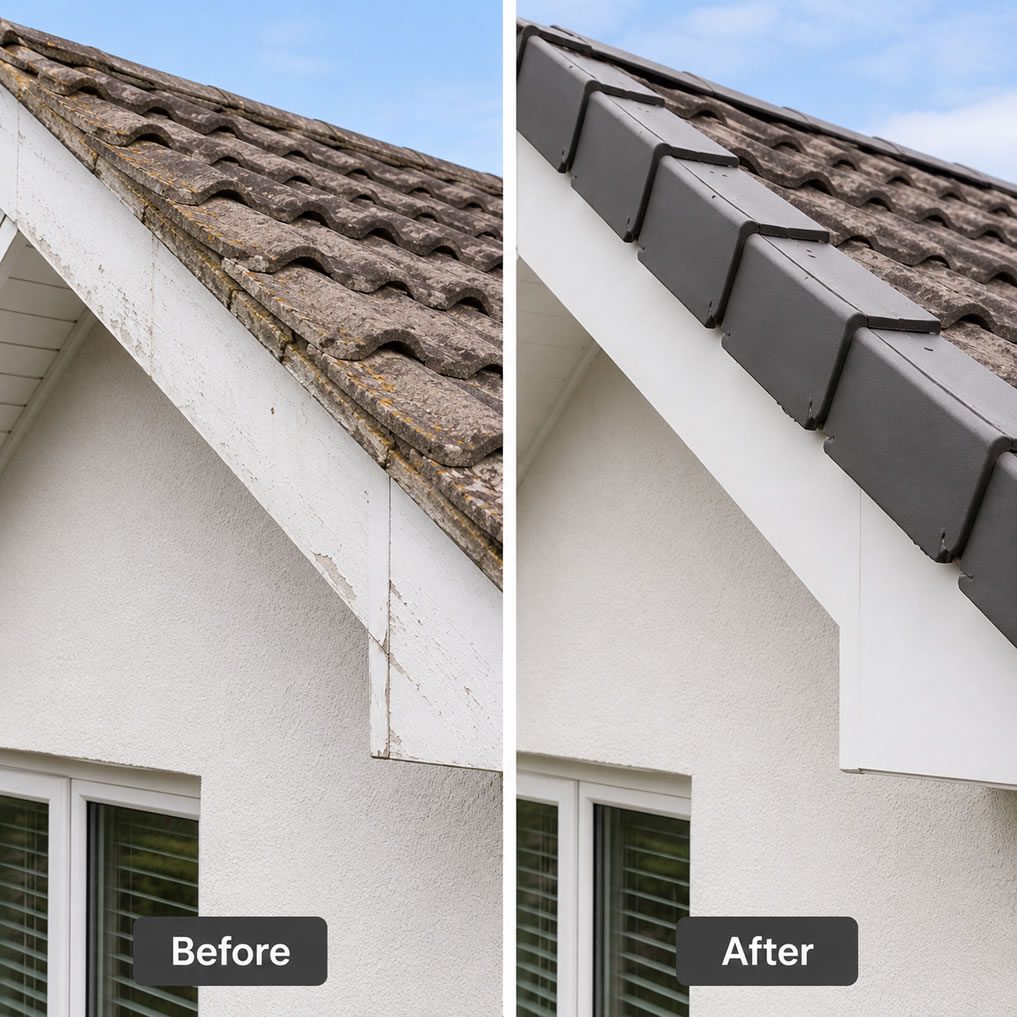
Replacing a roof verge with a modern dry verge system usually costs between £600 and £1,600 for a typical UK home. A straightforward installation on one accessible gable may cost less, while replacing the verge system on several roof sections can cost £2,000 or more.
For a standard semi-detached house, homeowners will often pay around £750 to £1,000, including labour and materials. However, scaffolding, damaged roof battens, broken tiles and awkward access can increase the final bill considerably.
Typical dry verge replacement cost
For most homeowners, a sensible planning budget is between £750 and £1,400 for replacing both verge edges on an average house. Smaller repairs may cost around £150 to £400, whereas larger detached properties with several gables may cost £1,500 to £3,000+.
Quick dry verge cost summary
| Type of dry verge work | Typical UK cost |
|---|---|
| Replace one loose dry verge cap | £150 to £250 |
| Replace several damaged verge units | £200 to £450 |
| Install dry verge on one gable end | £400 to £750 |
| Dry verge installation on a terraced house | £500 to £900 |
| Dry verge installation on a semi-detached house | £750 to £1,000 |
| Dry verge installation on a detached house | £900 to £1,600 |
| Large or multi-gable property | £1,500 to £3,000+ |
| Dry verge retrofit per linear metre | £35 to £75 |
| Remove mortar and install dry verge | £600 to £1,500+ |
| Continuous dry verge installation | £700 to £1,500+ |
| Scaffolding or access tower | £300 to £1,200+ |
| Verge tile and batten repairs | £200 to £1,000+ |
These prices provide a guide rather than a fixed tariff. The number of gables, roof height, tile profile, access arrangements and condition of the existing roof edge all affect the quotation. Current UK estimates commonly place full-house dry verge retrofits between approximately £800 and £1,600.
What is a roof verge?
The verge is the sloping edge of a pitched roof at the gable end of a building. It runs from the eaves at the bottom of the roof to the ridge at the top.
Because the tile edges remain exposed at this point, the verge needs protection from wind, rain, birds and insects. Traditionally, roofers bedded the edge tiles into mortar. Although that method can perform well when maintained, mortar eventually cracks and loosens as the roof moves and the weather changes.
A dry verge system replaces the exposed mortar with interlocking plastic or metal components. These parts mechanically secure the roof edge and form a barrier against weather and pest entry. Modern systems should comply with the relevant performance requirements for dry-fixed verge products.
What does a dry verge system do?
A correctly fitted system performs several jobs:
- covers the exposed tile ends
- helps secure the verge tiles against wind uplift
- keeps rain away from the roof edge
- reduces access for birds and pests
- gives the gable edge a neat finish
- removes the need for mortar repointing
- allows the roof edge to move without cracking mortar
Nevertheless, dry verge units only work properly when the roofer fixes them securely to sound battens or suitable verge structures. Simply pushing plastic caps over loose mortar does not create a proper installation.
What does a dry verge replacement quote include?
A complete quotation may include:
- inspecting both roof verges
- checking the roof tiles and battens
- erecting ladders, a tower or scaffolding
- removing the old dry verge units
- removing loose or failed mortar
- trimming or adjusting tile edges
- repairing or extending roof battens
- fitting starter units at the eaves
- mechanically fixing each verge unit
- installing the ridge or apex finishing cap
- replacing broken verge tiles
- clearing debris from gutters and paths
- removing waste from the property
However, quotes do not always cover the same work. For example, one roofer may include scaffolding and minor tile replacement, while another may price those items separately.
Therefore, ask for a written quotation that clearly explains the system, access method and any allowances for hidden batten damage.
Dry verge cost by property type
Property type provides a useful starting point because it indicates the likely number and length of the verge runs. Even so, extensions, dormers and cross-gabled roofs can make two apparently similar houses very different to price.
Terraced house dry verge replacement cost
A mid-terraced house may only have visible verges where the roof includes a front-facing gable, rear extension or dormer. End-of-terrace homes usually have at least one full gable end.
Typical cost
£500 to £900
A small front gable may cost less. In contrast, an end terrace with a full two-storey gable and awkward access may cost closer to the price of a semi-detached house.
Semi-detached house dry verge replacement cost
A typical semi-detached property provides the most common benchmark for dry verge installation.
Typical cost
£750 to £1,000
This price usually assumes two verge runs on one main gable, standard interlocking tiles and reasonable access. Current UK pricing guides use an average of around £875 for a conventional semi-detached installation.
If the house has a front gable, porch roof or rear extension, the additional verge sections can take the total beyond £1,200.
Detached house dry verge replacement cost
Detached homes often have two full gable ends. In addition, some have projecting front gables, garages or extensions.
Typical cost
£900 to £1,600
A simple detached house with two accessible verges may stay near the lower end. Conversely, multiple gables, tall elevations and difficult scaffold arrangements can push the total above £2,000.
Bungalow dry verge replacement cost
Although a bungalow has easier roof access, it may still have long verge runs or several roof sections.
Typical cost
£600 to £1,200
Lower working height can reduce access costs. However, a large detached bungalow with several gables may use more verge units than a compact two-storey house.
Three-storey house dry verge cost
Townhouses and taller homes often need scaffolding or powered access.
Typical cost
£1,000 to £2,000+
The dry verge materials may cost no more than they would on a lower property. Nevertheless, safe access can become the largest part of the quotation.
Multi-gable roof dry verge cost
Properties with several projecting gables, dormers or complex roof shapes require more starter units, apex caps and detailed cutting.
Typical cost
£1,500 to £3,000+
Each additional gable introduces two more verge runs. Moreover, small high-level sections can take longer to complete than one long uninterrupted edge.
Dry verge cost by type of system
Not every dry verge product works in the same way. The tile profile, appearance and existing roof construction will influence which system the roofer recommends.
Individual interlocking dry verge units
This is the most familiar type of dry verge. The roofer fixes a separate cap over the end of each row of tiles, with the units locking together as they move up the roof.
Typical installed cost
£35 to £75 per linear metre
Individual caps suit many concrete interlocking roof tiles. They are available in left-handed, right-handed and ambidextrous designs, depending on the manufacturer.
Because the units follow the tile courses, they create a stepped appearance along the gable. Starter pieces at the eaves and finishing caps near the ridge complete the system.
Universal dry verge system cost
Universal systems work with several compatible tile profiles, which can make them useful when retrofitting an existing roof.
Typical cost
£700 to £1,400 for an average house
Compatibility still matters. Therefore, the roofer should check the tile gauge, profile and roof pitch rather than assuming that any universal product will fit every roof.
Continuous dry verge cost
A continuous dry verge uses a longer profile that runs along the roof edge rather than separate caps over every tile course.
Typical cost
£700 to £1,500+
Continuous systems can create a straighter and less stepped appearance. They may suit plain tiles, slates or specific roof constructions, depending on the chosen profile. Manufacturers offer different continuous strips for tile, slate roofs and regional verge details.
Fitting may require the roofer to lift or adjust the verge tiles, so labour costs can vary.
Thin leading-edge dry verge cost
Some modern flat-profile tiles need a slimmer verge unit to match their shallow leading edge.
Typical cost
£750 to £1,500
These systems often cost slightly more than basic standard-profile caps. However, they can provide a neater finish on contemporary roofs.
Dry verge replacement versus first-time installation
Replacing an existing dry verge system is not always the same as converting an old mortar verge.
Replacing an existing dry verge system
Where the roof already has correctly prepared battens and compatible tiles, the roofer may only need to remove the failed units and fit new ones.
Typical cost
£500 to £1,200
Costs rise if the original installers used unsuitable fixings, failed to extend the battens correctly or fitted the wrong units.
Converting a mortar verge to dry verge
Retrofitting dry verge to a traditional roof edge usually involves removing loose mortar and preparing the battens before fitting the new system.
Typical cost
£600 to £1,500+
Dry verge can be fitted retrospectively, although installation is generally easier during a new roof or full roof replacement rather than a simple roof repair.
The contractor may also need to cut back excess mortar, repair the undercloak and replace cracked verge tiles. Consequently, converting from mortar often costs more than simply replacing existing plastic units.
Replacing failed mortar with a new mortar verge
Dry verge is not the only option. A roofer can also remove the failed material and rebuild the verge using fresh mortar.
Typical cost
£500 to £2,000
Mortar may look more appropriate on period homes or properties where plastic caps would change the appearance noticeably. Nevertheless, it will require maintenance over time because exposure and roof movement can lead to renewed cracking. Current market ranges for complete verge repointing or rebuilding vary widely according to access and roof size.
Individual dry verge cap replacement cost
Storms sometimes loosen one or two verge units while leaving the rest of the system intact.
Typical cost
£150 to £250 for one unit or a minor repair
The replacement cap itself costs relatively little. Most of the price covers the roofer’s time, travel and safe roof access.
Several damaged units may cost £200 to £450 to replace. However, the roofer should inspect the full run because repeated losses often indicate poor fixing rather than isolated product failure.
Why do dry verge units come loose?
A properly fitted dry verge should remain secure in normal weather. Units commonly loosen because of installation faults or deterioration in the supporting roof edge.
Possible causes include:
- missing screws or mechanical fixings
- fixing only into the end grain of weak battens
- rotten or split battens
- incompatible verge units
- poor engagement between adjoining caps
- incorrect tile spacing
- missing eaves starter units
- badly fitted ridge-end caps
- wind damage
- impact from ladders or maintenance work
- expansion and contraction
- clips fitted over failing mortar rather than sound supports
Modern installation guidance requires suitable mechanical fixing rather than relying on a simple nail driven into the end of the roof batten.
If several caps have started moving, replacing only the missing one may not provide a lasting repair.
Signs that a dry verge needs replacing
Common warning signs include:
- caps hanging loose from the roof edge
- missing units after strong winds
- gaps between individual caps
- cracked or faded plastic
- units that move by hand
- birds entering beneath the verge
- water staining on the gable wall
- exposed tile ends
- broken starter or apex pieces
- repeated repairs to the same area
- loose tiles at the gable edge
Some colour fading is cosmetic and does not necessarily mean the system has failed. On the other hand, brittle, cracked or poorly secured units usually justify closer inspection.
Common dry verge installation problems
Dry verge fitted over old mortar
Some installers attach plastic verge caps directly over a failing mortar verge without preparing proper mechanical support. Although the roof edge may initially look complete, the units can loosen because the underlying material does not provide a reliable fixing.
A correct repair may require removal of both the caps and loose mortar before the roofer rebuilds the edge.
Battens do not reach the verge
Dry verge units normally need secure fixing at the end of each tile course. If the battens stop too far short, the installer may need to extend them or use an approved fixing arrangement.
Typical additional cost
£200 to £800
Widespread batten damage can increase the cost further, especially if several rows of tiles need lifting.
Incorrect left- and right-hand units
Some products have separate units for each side of the roof. Using the wrong type can prevent proper interlocking and leave gaps.
Ambidextrous systems reduce that problem, although the product must still suit the roof tiles.
Missing starter or ridge components
Starter units secure the bottom of the system, while ridge-end caps finish the top. Missing or poorly fitted components can allow the whole run to move.
Typical repair cost
£150 to £400
Incorrect tile overhang
The verge tiles need to project by the amount specified for the chosen system. Too much or too little overhang may stop the caps from fitting securely.
Correcting this fault can involve lifting and repositioning several rows of tiles.
Typical cost
£400 to £1,200+
Broken or uneven verge tiles
Dry verge will not correct badly aligned or damaged roof tiles. The roofer may need to replace and reposition them before fitting the new system.
Typical additional cost
£100 to £500+
Additional dry verge replacement costs
The headline price may not include every part of the work.
Scaffolding cost
Two-storey gables often require a scaffold tower or full scaffold.
Typical additional cost
£500 to £1,200+
A simple access tower may cost less, while scaffolding around several gables can exceed £1,500. Some installers include access in the main quotation, so check before comparing prices.
Powered access cost
A cherry picker may suit a short repair where ground access allows it.
Typical additional cost
£300 to £700+
Delivery, operator costs and restricted access can increase the charge.
Roof batten repair cost
Rotten, short or damaged battens may not hold the new fixings.
Typical additional cost
£200 to £1,000+
The extent of the problem may only become clear after the roofer removes the existing caps and lifts the edge tiles.
Verge tile replacement
Old clay or concrete verge tiles can crack while the roofer removes mortar or adjusts the roof edge.
Typical additional cost
£10 to £40 per standard tile fitted
Rare, discontinued or decorative tiles may cost considerably more.
Roof felt or membrane repairs
Exposed or torn underlay near the gable can allow wind-driven rain into the roof space.
Typical additional cost
£250 to £1,000+
Small local repairs cost less, whereas replacing a longer strip may require several rows of tiles to come off.
Gable-end fascia or bargeboard repairs
Some roofs have timber or uPVC bargeboards beneath or beside the verge.
Typical additional cost
£300 to £1,500+
Rotten timber should be repaired before fitting the final verge details.
Ridge-end repairs
The dry verge system must finish neatly where it meets the ridge.
Typical additional cost
£150 to £500
The roofer may need to replace the ridge-end cap, renew mortar or adapt an existing dry ridge system.
Gutter and eaves repairs
The bottom verge unit meets the eaves close to the gutter. Damaged fascia boards or poorly positioned gutters can complicate the installation.
Typical additional cost
£150 to £800+
What affects dry verge replacement cost?
Several factors influence the final quotation.
1. Number of verge runs
A simple roof may have two sloping verge edges. By comparison, a multi-gabled property may have six, eight or more.
2. Length of each verge
Longer roof slopes require more units and labour. Consequently, a wide low-pitched roof may cost more than a compact steep roof.
3. Property height
Ground-floor porch work costs less than verge replacement on a three-storey townhouse.
4. Access
Conservatories, extensions, narrow side passages and neighbouring buildings can make scaffold erection more difficult.
5. Existing verge condition
Removing loose plastic units is usually straightforward. In contrast, stripping thick mortar and repairing tiles or battens adds considerable labour.
6. Tile profile
Standard concrete interlocking tiles work with many common systems. Plain tiles, thin leading-edge products and unusual profiles may require more specialist components.
7. Batten condition
Secure battens are essential. Rotten or undersized timbers must be repaired before the system can be fixed properly.
8. Type of dry verge
Basic interlocking caps tend to cost less than specialist continuous or low-profile systems.
9. Number of finishing components
Every separate gable needs eaves starters, ridge-end fittings and sometimes adaptors. Complex roofs therefore cost more per metre than one simple run.
10. Location
Labour and scaffolding usually cost more in London and parts of the South East. Parking and restricted access may add further expense.
Regional dry verge replacement prices
| UK region | Typical full dry verge installation |
| London | £1,000 to £2,000+ |
| South East England | £850 to £1,700 |
| South West England | £750 to £1,500 |
| Midlands | £700 to £1,400 |
| North of England | £650 to £1,300 |
| Wales | £650 to £1,300 |
| Scotland | £700 to £1,500 |
| Northern Ireland | £650 to £1,300 |
These figures assume a typical domestic roof. Several gables, extensive repairs or specialist access can increase costs in any region.
How long does dry verge replacement take?
Most standard installations take one to two days once access equipment is in place. A minor repair involving one or two units may only take a few hours.
More complex jobs can take two to four days, particularly where the roofer needs to:
- remove large amounts of old mortar
- repair or extend battens
- reposition roof tiles
- replace damaged underlay
- work around dormers or extensions
- renew several separate gables
Scaffolding may remain at the property for longer than the actual roofing work because erection and collection happen separately.
How long does a dry verge system last?
A good-quality system should provide many years of service when fitted correctly. Many manufacturers offer product guarantees, although the terms differ and may only cover the components rather than installation workmanship.
Service life depends on:
- product quality
- correct compatibility with the tiles
- secure mechanical fixing
- sound roof battens
- proper eaves and ridge finishing
- exposure to strong winds
- ultraviolet exposure
- impact or accidental damage
Poorly installed caps can fail within a short time, even if the product itself remains in good condition.
Is a dry verge better than mortar?
Neither option suits every property, although dry verge offers several practical advantages.
Benefits of dry verge
- no mortar to crack or repoint
- mechanical fixing at the roof edge
- quick installation in suitable conditions
- consistent appearance
- resistance to pest entry
- available in several colours and profiles
- can be retrofitted to many existing roofs
Possible disadvantages
- plastic caps may not suit every building style
- poor installation can lead to loose or missing units
- colours may fade over time
- incompatible products can look uneven
- hidden batten problems can increase installation cost
- heritage properties may look better with a traditional verge
Dry verge products can provide a more durable, low-maintenance finish than exposed mortar, but only when the system matches the roof and the contractor follows the fitting instructions.
Can dry verge be fitted over existing mortar?
Although some installers do this, fitting over old mortar is not always the right approach. Loose or projecting mortar can stop the caps from sitting correctly, while unsuitable fixing points may leave them vulnerable to wind.
A roofer should inspect the verge and remove enough defective material to prepare a sound edge. They may also need to adjust the battens and tiles.
Consequently, a quotation that includes proper preparation may cost more than a simple cap-over installation. Nevertheless, it is more likely to provide a secure long-term result.
Can individual dry verge caps be replaced?
Yes, replacing individual units can make sense when:
- storm damage affected only one or two caps
- the remaining system remains firmly fixed
- the same product is still available
- the supporting battens are sound
- adjoining units still interlock correctly
However, complete replacement may offer better value where the original system has widespread movement, poor fixings or brittle plastic. Partial repairs are unlikely to last if the entire run was installed incorrectly.
Do dry verge systems need maintenance?
Dry verge requires less routine maintenance than mortar, but it is not entirely maintenance-free.
Homeowners should visually check for:
- missing caps
- loose finishing pieces
- movement after storms
- cracked units
- displaced verge tiles
- gaps that allow bird entry
Avoid pulling or testing caps from a ladder. Instead, arrange a roofer’s inspection if anything appears loose.
Is dry verge replacement suitable for DIY?
Dry verge products may look simple to clip together. However, the work takes place at an exposed roof edge, where a fall could cause serious injury.
The installation may also involve tile cutting, batten repairs and precise mechanical fixing. Dry cutting roof tiles can create high levels of silica dust, so contractors need suitable controls and safer cutting methods.
Official safety guidance treats all roof work as high risk, even when the task only takes a few minutes. Proper planning, competent workers and safe access remain essential.
For that reason, professional installation is usually the sensible option on pitched roofs.
Does dry verge replacement need planning permission?
Routine dry verge repair or replacement will not normally require planning permission on a standard house, provided the work does not materially alter the building’s appearance.
However, different considerations may apply when the property is:
- listed
- within a conservation area
- subject to an Article 4 direction
- part of a managed development
- being altered beyond a straightforward repair
Most ordinary repair and maintenance work does not need separate Building Regulations approval. Nevertheless, larger roofing projects, including substantial replacement of the roof covering, may fall under different requirements. Homeowners should check with the local planning authority or building control body when the project forms part of wider roof work.
Choosing a dry verge installer
Before accepting a quotation, ask the roofer:
- Which dry verge system will you use?
- Is it compatible with my roof tiles?
- Will you remove the existing mortar?
- How will each unit be mechanically fixed?
- Are the roof battens long and strong enough?
- Does the quote include starter and ridge-end caps?
- Will you replace broken verge tiles?
- Is scaffolding included?
- What happens if you find rotten battens?
- Does the quote include waste removal?
- Is there a workmanship guarantee?
- Do you carry public liability insurance?
A reliable contractor should explain how they will secure the system rather than simply saying that they will “fit plastic caps”.
Example dry verge replacement budgets
Example 1: replacing several storm-damaged caps
- roofer call-out and inspection: £100 to £180
- replacement caps and fixings: £30 to £80
- access and labour: £70 to £200
- likely total: £200 to £450
Example 2: one gable on a bungalow
- old verge removal and preparation: £150 to £300
- dry verge materials: £100 to £250
- installation labour: £250 to £450
- likely total: £500 to £1,000
Example 3: standard semi-detached house
- mortar removal and preparation: £200 to £400
- dry verge system: £150 to £350
- labour: £350 to £600
- likely total: £750 to £1,350
Example 4: detached house with two gables
- removal and preparation: £300 to £600
- dry verge materials: £250 to £500
- labour: £500 to £900
- access equipment: £300 to £800
- likely total: £1,350 to £2,800
Example 5: replacement with batten and tile repairs
- removal of failed dry verge: £200 to £400
- batten and membrane repairs: £300 to £900
- replacement tiles: £100 to £350
- new dry verge system: £250 to £500
- scaffolding and labour: £600 to £1,200
- likely total: £1,450 to £3,350
Is dry verge replacement worth the cost?
Dry verge replacement can make sense when the old mortar has started cracking or an existing system keeps losing caps. A properly fixed system protects the exposed tile ends and removes the need for regular mortar repointing.
Furthermore, replacing the verge gives the roofer an opportunity to inspect the edge tiles, underlay and battens. Early repairs can prevent wind-driven rain, pest entry and loose tiles from causing more extensive problems.
Even so, the quality of installation matters more than choosing the cheapest plastic units. A low-cost cap-over job may hide failing mortar or weak battens rather than solving the underlying problem.
FAQs about roof dry verge replacement costs
How much does dry verge replacement cost in the UK?
A full dry verge installation typically costs between £600 and £1,600. A standard semi-detached house often costs around £750 to £1,000, while larger multi-gable properties may exceed £2,000.
How much does it cost to install dry verge on one gable?
Installing dry verge on one standard gable usually costs around £400 to £750. Scaffolding, damaged battens and difficult access can raise the total.
How much does dry verge cost per metre?
A typical retrofit costs approximately £35 to £75 per linear metre, although many roofers quote for the complete gable rather than by length.
How much does it cost to replace one dry verge cap?
Replacing one missing or loose cap may cost around £150 to £250 because the roofer still needs to travel to the property and arrange safe access.
Is scaffolding included in dry verge installation prices?
Not always. Scaffolding or an access tower may add £300 to £1,200+, depending on property height and the number of gables.
Can dry verge be fitted over old mortar?
It may be physically possible, but it is not always good practice. Loose mortar can prevent correct fitting and may not provide a reliable fixing point. Proper preparation often involves removing failed material and checking the battens.
Can individual dry verge units be repaired?
Yes. An isolated damaged unit can often be replaced when the rest of the system remains secure and a matching component is available.
Why do dry verge caps fall off?
Common causes include poor mechanical fixing, rotten battens, missing starter units, incompatible products and failure to interlock the caps correctly. Strong winds may expose these existing installation faults.
Is dry verge better than a mortar verge?
Dry verge needs less routine maintenance and does not crack like mortar. However, some homeowners prefer mortar on traditional properties, and either system can fail when installed poorly.
How long does dry verge installation take?
Most standard installations take one to two days, excluding scaffold erection. More complex work involving batten, tile or membrane repairs may take several days.
Does dry verge require planning permission?
Routine replacement usually does not require planning permission. Listed buildings, conservation areas and projects that significantly change the roof’s appearance may need additional checks.
How long should a dry verge system last?
A quality system can last for many years when the roofer fits it to compatible tiles and secures it to sound battens. Poorly fixed systems may start loosening much sooner.